
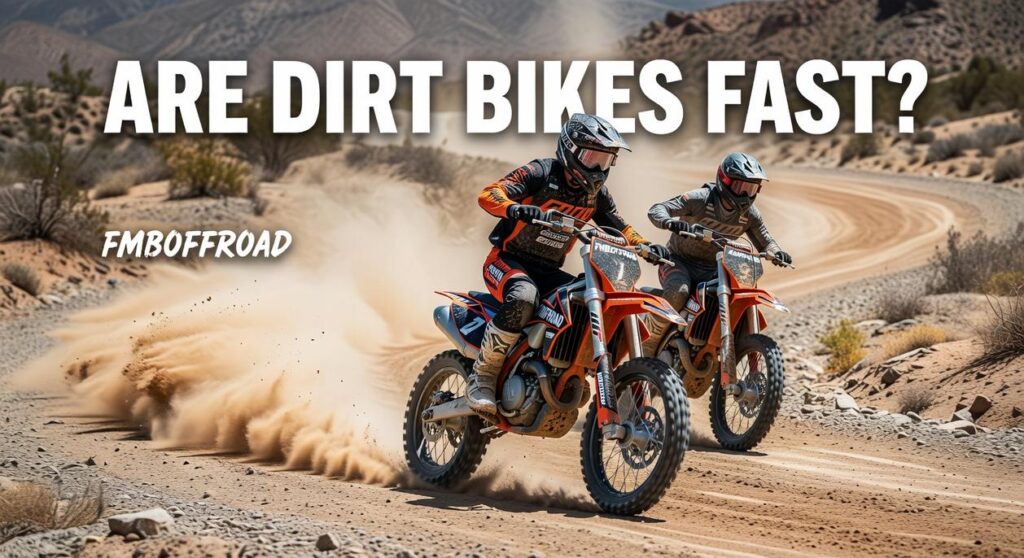
I’ve ridden enough dirt bikes to know that the top speed number in a spec sheet doesn’t tell you much about how fast you’ll actually go.
You’re probably here because you want to know how fast racing dirt bikes can really go. Maybe you’re comparing models or trying to figure out if that 450 can hit the speeds you’ve heard about.
Here’s the thing: top speed on dirt is nothing like top speed on pavement. The terrain changes everything.
I’ve spent years testing bikes on actual tracks and trails. Not just reading manufacturer claims. I’m talking about real conditions where traction matters and obstacles force you to think differently about speed.
This article gives you the numbers you came for. But I’m also going to show you why those numbers don’t mean what you think they mean.
Are dirt bikes fast fmboffroad depends on factors most riders never consider. Suspension setup matters more than horsepower in most situations. Gearing can make or break your performance on different terrain.
You’ll learn what actually makes a racing dirt bike fast when you’re trying to post better lap times. Not theoretical speed. Real speed you can use.
I’ll break down the physics that matter and show you how to set up your bike for the kind of fast that wins races.
The Short Answer: Top Speed by Dirt Bike Class
Let’s cut right to it.
You want to know how fast dirt bikes actually go. Not the marketing numbers. The real speeds you’ll see on a track or trail.
Here’s what you need to know by class.
125cc 2-Stroke bikes typically hit 55 to 65 mph. These things scream. They rev high and fast, which makes them perfect for tight tracks where you’re constantly on and off the throttle. (Think of them as the lightweight boxers of the dirt bike world.)
The sweet spot? 250cc bikes. Both 2-stroke and 4-stroke versions live in the 60 to 75 mph range. This is the most common racing class for a reason. You get enough power to clear jumps and pass on straights, but the bike stays nimble enough to handle technical sections.
Now 450cc 4-stroke bikes are the big dogs. They can push 80 to 95 mph or even higher under the right conditions. But here’s the catch most people miss.
You almost never use that top speed.
On a motocross track? You might hit 60 mph for a few seconds on the longest straight. In enduro racing through trees and rocks? Even less. These bikes are are dirt bikes fast fmboffroad machines built for acceleration and power delivery, not sustained high speeds.
One thing you need to understand. Those numbers I just gave you? They’re manufacturer estimates under perfect conditions. Swap your gearing for better acceleration and you’ll lose top speed. Add 20 pounds of rider weight or hit soft sand, and those numbers drop fast.
The terrain changes everything.
Why Top Speed is the Wrong Metric for Off-Road Racing
I see it all the time at the track.
Someone shows up with a bike that hits 85 mph on paper and expects to dominate. Then they get smoked by a rider on a slower machine who just knows how to use what they’ve got.
Here’s what most people don’t understand about are dirt bikes fast fmboffroad.
Top speed barely matters.
Now, some riders will argue with me on this. They’ll point to their GPS data and say speed is everything. They’ll show me straight sections where they pulled away from the pack.
And sure, if you’re racing the Baja 1000 across open desert, top speed has its place.
But that’s not what most of us are doing.
Think about the last time you actually pinned it in sixth gear during a race. How long did that last? Three seconds? Five?
The rest of the time you’re braking, cornering, and trying to get back on the gas as fast as possible.
Acceleration Wins Races
What really matters is how quick you can get from 0 to 40 mph coming out of a turn.
That’s where races are won. Not on some theoretical top speed you’ll never reach because there’s another corner in 100 feet.
I’ve watched riders gain entire bike lengths just by getting on the power sooner. Their bikes might top out at 70 mph, but they hit 40 faster than anyone else.
The math is simple. More corners mean more chances to accelerate. And the bike that accelerates harder wins.
Power Delivery Beats Peak Numbers
This is where things get interesting.
A bike with 50 horsepower that hits hard at 6,000 RPM will feel faster than one with 55 horsepower that needs 9,000 RPM to wake up.
Why? Because you’re constantly in that mid-range when you’re racing. You need torque right now to:
- Clear that log you just hit
- Power through deep sand
- Pull yourself up a steep hill
- Recover when you bog the engine
Peak horsepower at redline doesn’t help you when you’re lugging through a rock garden at 15 mph.
The powerband is everything. I’d rather have a bike that pulls strong from 4,000 to 8,000 RPM than one that screams at 11,000 but feels flat everywhere else.
(This is why two-strokes still have such a loyal following, by the way.)
The Track Decides What Fast Means
A bike set up for motocross will get destroyed in the desert.
And a desert bike? Good luck throwing that thing around a tight MX track.
Motocross demands snap. You need to accelerate hard out of every corner because the next one is coming fast. Gearing is shorter. Suspension is stiffer. Top speed might be 65 mph and that’s fine.
Enduro racing is different. You need a wider powerband because terrain changes every minute. One second you’re in third gear climbing rocks, the next you’re in fifth on a fire road.
Hare scrambles fall somewhere in between, but they still favor bikes that can change direction and accelerate rather than hold top speed.
I’ve seen guys regear their bikes three different ways for three different types of races. Same bike, completely different performance characteristics.
The fastest bike is the one that matches what the track demands. Not what the spec sheet says.
The 4 Key Factors That Control Your Bike’s Real-World Speed
You can have the fastest bike on paper and still get smoked on the track.
I see it all the time. Riders obsess over horsepower numbers and top speed specs but can’t figure out why they’re not going any faster.
Here’s what actually matters.
Your bike’s real-world speed comes down to four things. And most riders only pay attention to one of them (if that).
Let me break this down.
Gearing: The Speed vs. Acceleration Trade-Off
Your sprockets control everything.
The front sprocket drives the chain. The rear sprocket receives that power. The relationship between their tooth counts determines whether you’re built for speed or snap.
Smaller rear sprocket means higher top speed but slower acceleration. You’ll struggle out of corners but fly on straightaways.
Larger rear sprocket does the opposite. You’ll rocket out of turns but hit your ceiling early.
For tight woods riding, I run a larger rear. For open desert or supercross, I go smaller. It’s that simple.
Engine Type & Tuning: Where Your Power Lives
Are dirt bikes fast fmboffroad? Depends on what kind of fast you mean.
A 2-stroke hits HARD and revs quick. The power comes on like a light switch. You get instant response but a narrow powerband.
A 4-stroke builds power differently. It’s broader and more controlled. You can lug it through corners and still have pull.
Your exhaust system changes where that power shows up. A shorter pipe shifts the powerband higher. A longer pipe brings it down low.
ECU tuning does the same thing but with fuel and ignition maps instead of pipe length.
Tires & Terrain: The Grip Factor
Power means nothing if you can’t put it down.
Soft terrain tires have tall knobs that dig into loose dirt. Intermediate tires work for most conditions. Hard terrain tires have shorter knobs for packed surfaces.
Run the wrong tire and you’ll spin instead of grip. I’ve watched guys with more power lose races because their rear tire just painted lines in the dirt.
Tire pressure matters too. Too high and you bounce. Too low and you risk pinch flats or tire roll.
Most riders run 12 to 14 psi but you need to test what works for your weight and riding style.
Suspension Setup: The Confidence Multiplier
This is the one everyone ignores.
A bike that kicks and swaps won’t let you use full throttle. You’ll be too busy hanging on to actually go fast.
Proper suspension keeps your tires planted. It soaks up bumps instead of throwing you around. It stays predictable when you’re pushing hard.
When your suspension is dialed, you trust the bike. And trust is what lets you pin it through sections where you used to back off.
That’s the difference between fast on paper and fast in real life.
Get your best motorcross gloves fmboffroad sorted and start paying attention to these four things. Your lap times will tell you everything you need to know.
Practical Tuning: Gearing Your Bike for Victory
You can have the best suspension setup and perfect tire pressure, but if your gearing is off? You’re leaving time on the table.
I see riders show up to tracks with stock gearing and wonder why they can’t keep pace. The truth is, one size doesn’t fit all when it comes to sprockets.
Let me break down what actually works.
The Tight Technical Track
When you’re dealing with a course that’s all tight turns and short straights, acceleration matters more than top speed.
Go up one or two teeth on the rear sprocket. This gives you snappier response out of corners and helps you claw back time where it counts.
Think about it. If you’re only hitting third gear for a few seconds between turns, why gear for speed you’ll never use?
The Fast Flowing Course
Now flip the script.
On tracks with long straights and sweeping turns, you need a different approach. Consider dropping one tooth on the rear sprocket to stretch out your gearing.
This keeps your engine from screaming at the rev limiter when you’re wide open. You’ll carry more speed without that feeling like your bike is about to explode.
(And your engine will thank you for it.)
But here’s what most people miss. Before you commit to any gearing change, ask yourself which helmet should i buy fmboffroad for the type of riding you’re doing. Safety comes first.
The Golden Rule
Test and adjust.
Perfect gearing is always a compromise. What works on paper might feel wrong on the track. That’s why I always run practice laps before making final calls.
Start with small changes. One tooth at a time. Pay attention to how your bike pulls and where you’re shifting.
Some riders wonder are dirt bikes fast fmboffroad compared to other setups. The answer depends entirely on how well you’ve matched your gearing to the conditions.
Take notes after each session. What felt good? Where did you struggle? Dial it in until it clicks.
It’s Not How Fast It Can Go, It’s How Fast You Can Go
You came here looking for top speed numbers. I gave you those.
But now you know the real story.
A single top speed figure means almost nothing when you’re riding off-road. The dirt doesn’t care what the spec sheet says.
What matters is how your bike is set up. Gearing that matches your terrain. Suspension that keeps you planted. Power delivery you can control.
are dirt bikes fast fmboffroad depends entirely on how well you’ve dialed in these variables.
I’ve seen riders on paper-slow bikes destroy the competition because they understood their machine. They stopped chasing numbers and started chasing performance.
Here’s what you should do: Stop staring at spec sheets. Get out and experiment with your gearing. Adjust your setup for the trails you actually ride.
Your bike is faster than you think. You just need to find that speed through testing and tuning.
The answer was never in the manual. It’s in the dirt.
 Founder & Chief Adventure Director
Tynovox Ridge is the visionary founder behind FMBOffroad.com, a platform built for riders who crave adrenaline, exploration, and the freedom of off-road culture. With years of experience in motorcycle adventures and trail discovery, he created the brand to connect enthusiasts with authentic riding experiences and industry insights. Tynovox is known for his fearless mindset, leadership in outdoor motorsports, and passion for pushing boundaries beyond the pavement. His hands-on approach keeps the company closely connected to the off-road community and evolving riding trends. From coordinating adventure campaigns to guiding the brand’s creative direction, he continues to shape FMBOffroad.com into a trusted destination for riders worldwide. His dedication to adventure culture inspires both seasoned riders and newcomers alike.
Founder & Chief Adventure Director
Tynovox Ridge is the visionary founder behind FMBOffroad.com, a platform built for riders who crave adrenaline, exploration, and the freedom of off-road culture. With years of experience in motorcycle adventures and trail discovery, he created the brand to connect enthusiasts with authentic riding experiences and industry insights. Tynovox is known for his fearless mindset, leadership in outdoor motorsports, and passion for pushing boundaries beyond the pavement. His hands-on approach keeps the company closely connected to the off-road community and evolving riding trends. From coordinating adventure campaigns to guiding the brand’s creative direction, he continues to shape FMBOffroad.com into a trusted destination for riders worldwide. His dedication to adventure culture inspires both seasoned riders and newcomers alike.